
Although Howe’s efforts to establish a formal Mother’s Day for Peace didn’t succeed, her vision was shaped by another pioneering woman: Ann Jarvis. In 1858, Jarvis, a young Appalachian homemaker, organized "Mothers' Work Days" to promote better sanitation in her community. During the Civil War, she mobilized women to improve sanitary conditions for soldiers on both sides, and in 1868, she led efforts to reconcile former Union and Confederate neighbors.
When Ann Jarvis passed away in 1907, her daughter, Anna Jarvis, took up the cause with a new mission — to create a national day honoring mothers. The first official celebration was held on May 10, 1908, in Grafton, West Virginia, at Andrews Methodist Episcopal Church, where the elder Jarvis had once taught Sunday school. That church is now recognized as the International Mother's Day Shrine, a National Historic Landmark. The idea quickly spread, and by 1912, several states had adopted the holiday. In 1914, President Woodrow Wilson proclaimed Mother’s Day a national observance, encouraging citizens to fly the flag in honor of mothers whose sons had died in war.
Ironically, just nine years later, Anna Jarvis herself became one of the holiday’s fiercest critics as it became increasingly commercialized. Despite her protests, Mother's Day evolved into one of the most commercially successful holidays in the U.S. Today, it's not only a time for cards, flowers, and gifts — according to the National Restaurant Association, it's also the most popular day of the year to dine out in America.

(Pssst, if you didn't get your mom a great gift, just remind her that you will be the one arranging for her nursing home stay.)
May 11, 12 and 13 are the feast days of Saints Mamertus, Pancras and Servais (or Servatuis or Gervatuis.) These three are known as the The Icy Saints not because they were cold during their lifetimes, but because these days are traditionally the coldest of the month. English and French folklore (and later American) held that these days would bring a late frost. In Germany, they were called the Icemanner, or Icemen Days, and people believed it was never safe to plant until the Icemen were gone.

Allow you mind to wander to think of all the dirty jokes you can now tell yourself.
May 11, 1931 -
Fritz Lang's first sound film, M (Eine Stadt sucht einen Mörder), starring Peter Lorre, premiered in Berlin on this date.
Fritz Lang's cruelty to the actors was legendary. Peter Lorre was thrown down the stairs into the cellar over a dozen times. When Lang wanted to hire Lorre for Human Desire over two decades later, the actor refused.
May 11, 1936 -
Universal Pictures' semi-sequel of the 1931 film Dracula, Dracula's Daughter, starring Otto Kruger, Gloria Holden and Edward Van Sloan, premiered in the US on this date.
Completed for $278,000 it was one of Universal's most expensive productions of the 1930s.
May 11, 1955 -
The sequel to the film Creature from the Black Lagoon, Revenge of the Creature, went into general release, on this date. It's notable for being the only sequel to a 3-D film also shot in 3-D.
A young Clint Eastwood makes his first uncredited screen appearance as lab technician Jennings. He discusses with Professor Ferguson (John Agar) about an experiment involving a cat and four rats sharing the same cage. He points out that one of the rats in the cage is missing and accuses the cat of eating it, but discovers that the missing rat was in his lab coat pocket.
May 11, 1965 -
The Byrds made their TV debut on NBC's Hullabaloo, performing Mr. Tambourine Man, on this date.
Bob Dylan wrote Mr. Tambourine Man, which was originally released on his fifth album, Bringing It All Back Home, on March 22, 1965. His version wasn't released as a single, but when The Byrds released their cover on April 12, 1965, it was a transatlantic hit, topping the charts in both the US (on June 26) and UK (on July 22). It's the only song Dylan ever wrote that went to #1 in America (in the UK, Manfred Mann's cover of Quinn The Eskimo also went to #1).
May 11, 1968 -
Richard Harris released a song about an unfortunate accident with pastry, MacArthur's Park, written by Jimmy Webb, on this date. It ultimately climbed to No. 2 on the Billboard Charts. 10 years later, Donna Summer sang about the same experience but her version hits No. 1 on the charts.
Richard Harris sang the title as "MacArthur's Park," and since he was the first to record it, that's how most others (including Donna Summer), sang it. When the song's writer, Jimmy Webb, recorded it for his 1996 album Ten Easy Pieces, he sang it as "MacArthur Park." (Please forgive me if you find yourself humming the song all day long.)
May 11, 1969 -
It's ... the day the Monty Python comedy troupe was formed.
John Cleese and Graham Chapman were introduced to Terry Gilliam, Eric Idle, Terry Jones and Michael Palin on the set of their British TV series, Do Not Adjust Your Set.
May 11, 1972 -
In an effort to shed his teenybopper image, David Cassidy appears shirtless (and pantless) on the cover of Rolling Stone.

May 11, 1974 -
ABC Records released Steely Dan's Any Major Dude Will Tell You, on this date, (oh yeah, Rikki Don't Lose that Number was the A-side.)
"Have you ever seen a Squonk's tears," a Squonk is a mythical woodland creature who has the ability to dissolve in its own tears. Steely Dan came across the word in a book by Jorge Luis Borges. Genesis also makes mention of this animal in their song Squonk, from their 1976 album A Trick of the Tail.

Today in History:
May 11, 1310 -
For you fans of the Da Vinci Code, 54 members of the Knights Templar were burned at the stake in France for being heretics on this date.

May 11, 1812 -
Spencer Perceval was a British statesman and Prime Minister. He is the only British Prime Minister to have been assassinated. On this date in 1812, Perceval was on his way to attend a session of Parliament when he was shot through the heart in the lobby of the House of Commons by a mentally unsound man, John Bellingham, who blamed his financial instability on a casual suggestion of Perceval.
He died almost instantly, uttering the words "I am murdered", and Bellingham gave himself up to officers. He was found guilty and hanged a week later. It is often thought to be illegal to die in the Palace of Westminster, and the place of his actual death and the place of his recorded death are unknown.
May 11, 1888 -
Israel Isidore Beilin was a Russian-born naturalized American composer and lyricist, and one of the most prolific American songwriters in history. Irving Berlin was one of the few Tin Pan Alley/ Broadway songwriters who wrote both lyrics and music for his songs.
Although he never learned to read music beyond a rudimentary level, with the help of various uncredited musical assistants or collaborators, he eventually composed over 3,000 songs, many of which (e.g. God Bless America, White Christmas, Anything You Can Do, There's No Business Like Show Business) left an indelible mark on American music and culture. He composed 17 film scores and 21 Broadway scores.
May 11, 1907 -
A derailment outside Lompoc, California killed 32 Shriners, when their chartered train jumps off the tracks at a switch near Surf Depot on this date.
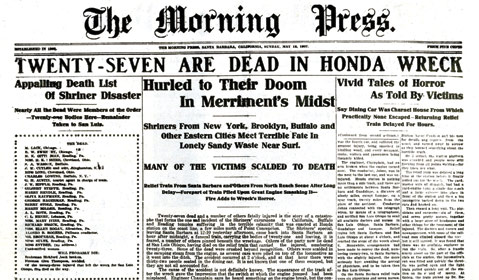
No word on the fate of their groovy fezzes.
May 11, 1949 -
Siam changed its name to Thailand on this date, because everyone was getting tired of those jokes where one guy would say, "Are you familiar with this place?" and the other guy would go "Yeah, Siam," and the first guy would go, "You gonna tell me where we are?" and the other guy would be like, "Yes: Siam." and it would go on and on and they'd never give it a rest.
Had anyone foreseen the glut of restaurants trading on the new name, however - Beau Thai, Thai Me Up, Thai One On, etc—the nation might still be called Siam. (The country had been known as Siam until 1939, when it changed its name to Thailand for nationalistic reasons. It reverted back to Siam in 1945, but when the political scene changed again, it was once again named Thailand.) I'm not going to mention that Constantinople, previously the town of Byzantium and later to be known as Istanbul, was founded in 330 AD.
May 11, 1960 -
Four Mossad agents on this date, abducted factory foreman, junior water engineer and professional rabbit farmer Ricardo Klement
(and, oh yeah, he was also know as fugitive Nazi war criminal Adolf Eichmann) from a bus stop in Buenos Aires.
May 11, 1981 -
Jamaican music legend and U.N. Peace Medal recipient Bob Marley died of brain cancer in a Miami hospital at the age of 36 on this date.
Marley had quietly begun a course of radiation therapy at Sloan-Kettering a few months prior, but abandoned it just two days later after word leaked out.
May 11, 2011 -
One of the rarest rock T-shirts in the world — a 1979 Led Zeppelin T-shirt from their 1979 Knebworth gig, — sold for $10,000 on eBay, on this date, to an anonymous Australian bidder.
It was the largest sum ever paid for a vintage tee at the time. The seller, Kyle Ermatinger, originally purchased the used t-shirt for $123 and believed that he had overpaid for it.
And so it goes.

No comments:
Post a Comment