Read the ramblings of Dr. Caligari. Hopefully you will find that Time does wound all heels.
You no longer need to be sad that nowadays there is so little useless information.
Today is Boxing Day (St. Stephen's Day) and citizens of the British Commonwealth celebrate by putting on trunks and gloves to beat each other bloody silly.
Another reason to appreciate the American Revolution - a peaceful December 26th.
If you are starting your Christmas shopping for 2017, you're either way ahead of the curve or cheap.
Tonight's the first night of Kwanzaa.
Kwanzaa means "first fruit" in Swahili.
It's the third night of Hanukkah -
Move on to the donuts.
If you're keeping score, you currently have two turtledoves and a pair of partridges in their respective pear trees (4 gifts - we're counting the partridge and a pear tree as a unit.)
Begin hoarding newspaper - you'll need it in a major way.
Also can 2016 just end quickly before we lose another celebrity before their time -
Georgios Kyriacos Panayiotou - R.I.P.
December 26, 1951 -
The film that introduced Akira Kurosawa to world audiences, Rashomon, starring Toshiro Mifune and Machiko Kyo, premiered in the US on this date.
In the downpour scenes showing the Rashomon Gate, Akira Kurosawa found that the rain in the background simply wouldn't show up against the light gray backdrop. To solve this problem, the crew ended up tinting the rain by pouring black ink into the tank of the rain machine. The ink is clearly visible on the Woodcutter's face just before the rain stops.
December 26, 1957 -
The Ingmar Bergman classic Wild Strawberries, starring Victor Sjostrom, opened in Sweden on this date.
Ingmar Bergman wrote the movie with Victor Sjöström in mind. He and the production company agreed that there would be no movie without Sjöström. Bergman didn't dare to call his idol Sjöström himself about the movie though, so the head of Swedish movie industry made the call.
December 26, 1967 - The Beatles gave their fans a Christmas present - Magical Mystery Tour was shown on the BBC on this date.
(I can't seem to embed a version of the show but check out the link above)
One artist who was cast in this film but didn't appear was Jimi Hendrix. Paul McCartney wanted him in the film, but Hendrix was already committed to play at the Monterey Pop Festival, his breakthrough performance. Ironically, McCartney was the person who suggested that Hendrix should get invited to play the festival.
December 26, 1973 -
Here was a great way to celebrate the holidays, The Exorcist, premiered in the US on this date.
Mercedes McCambridge, who provided the voice of the demon, insisted on swallowing raw eggs and chain smoking to alter her vocalizations. Furthermore, the actress who was an alcoholic, wanted to drink whiskey as she knew alcohol would distort her voice even more, and create the crazed state of mind of the character.
. Today in History: December 26, 1776 -
American forces under Gen. George Washington, having crossed the Delaware River on Christmas night, defeated Hessian mercenary troops fighting for the British at the Battle of Trenton, N.J. on this date.
Apparently, Washington was trying to beat the toll and may have been on the wrong side of Gov. Christie.
December 26, 1865 -
I'm not a fan of coffee but why isn't this a bigger deal - James Mason (sometimes known as Nason) of Franklin, Massachusetts registered the first U.S. patent (US Patent No. 51,741) for a coffee percolator on this date.
Coffee had really taken off in America after the tea supply was cut off during the War of 1812. By the 1860s, it had become a highly demanded commodity, and only increased in popularity with the invention of the percolator.
On this day in 1913, the author of the short story, An Occurrence at Owl Creek Bridge and the satirical dictionary, The Devil's Dictionary, Ambrose Bierce disappeared into Mexico while traveling with the army of rebel Pancho Villa. In one of his final letters, the 71-year-old Bierce wrote to his niece, Lora,
Good-bye — if you hear of my being stood up against a Mexican stone wall and shot to rags please know that I think that a pretty good way to depart this life. It beats old age, disease, or falling down the cellar stairs. To be a Gringo in Mexico—ah, that is euthanasia!
December 26, 1919 -
Red Sox owner and Broadway Producer, Harry Frazee believed he has solved one of his many headaches when he sold, an overweight, drunk, whoremongering baseball player to the New York Yankees on this date
Oops.
December 26, 2004 -
A massive tsunami caused by a 9.0 magnitude earthquake, devastated Southeast Asia, killing more than 250,000 people in a single day and more than half a million lost their homes. This was most devastating tsunami in modern times
The earthquake has been titled the Sumatra-Andaman Islands Earthquake and is the highest magnitude earthquake in the region in over 40 years. The event had the fourth largest death toll from an earthquake in recorded history. Ten years after the quake and tsunami events, the entire region is still trying to recover and to rebuild. Some areas will never recover.
Put your feet up and read a little bit about the History of Christmas
Christmas is one of the most widely celebrated holidays in the world, although the form of its observation varies widely from nation to nation. In America, our cultural kleptomania has allowed us to assimilate the most enjoyable of those traditions while discarding any stupid superstitions associated with them.
But it's worth reviewing those superstitions along with our traditions, if only to amuse ourselves yet again at the expense of our ancestors.
The winter solstice had long been celebrated by ignorant barbarians throughout the northern hemisphere as the time of the year when the sun stopped getting smaller and smaller and finally started getting bigger and bigger. The sun was important to these poor primitive bastards, in much the same way that we poor modern bastards find it so important. It was, after all, the sun.
To avoid having to go out much during the darkest and coldest days of the year, the poor shivering Nordic bastards of Scandinavia would bundle up and sally forth into the woods to bring home great big logs which would often burn for as long as twelve days. As long as the log burned they would stay in and eat and drink and fornicate. They believed that every spark their log set off foretold the birth of a calf or pig in the new year, which only underscores the irony of the Nobel prize being awarded in Sweden.
They believed the sun was a big wheel (hwoel) that rolled away from the earth until the winter solstice, at which point it began rolling back toward us. This quaint ignorance charmed the weak and flabby peoples over whom the Vikings later swept like an apocalyptic affliction. However, these peoples could not pronounce hwoel and therefore called it "yule." This irritated the Vikings and eventually forced their retreat.
While the Norse were hauling those logs into their houses, others throughout Europe were enjoying some of the finest dining of the year. Since it was too expensive to feed and shelter animals through the cold weather, those in northern climes killed their livestock at the onset of each winter. This provided their only steady supply of fresh meat all year, and went nicely with the wines and ales which had finally become fermented. The inevitable gastrointestinal distress that followed these binges is probably responsible for the primitive Germans' fear that the god Odin was flying around the sky above them during the solstice, deciding who was naughty and who was nice. It was not entirely academic: Odin's invariable sentence for the naughty was death.
Peasants everywhere also liked to bring sprigs and boughs of evergreens into their homes around the time of the solstice to remind themselves that sooner or later all that awful cold and snow would end and it would get warm enough to eat, drink, and fornicate outdoors. The Druids of the British Isles brought evergreen boughs into their temples every winter as a sign of everlasting life, and the Vikings thought that evergreens were the particular plant of their own sun-god, Balder (so-named because they mistook the sun for his shiny, hairless cranium). Even the Egyptians worshiped their sun-god Ra's "recovery" by bringing palm rushes into their homes. It's not clear how this was intended to help poor Ra, but he always pulled through.
In ancient Rome, the festival of Saturnalia began the week before the solstice and lasted a full month. Romans ate and drank and fornicated during this festival in honor of Saturn, the god of Agriculture. They filled their homes with evergreen boughs to remind themselves that everything would be green again eventually. They also let slaves become masters for the duration of the festival, and the plebeians were put in charge of the city. It was a crazy, topsy-turvy time, with all sorts of nutty mix-ups. Overlapping with Saturnalia around the time of the solstice was Juvenalia, a feast to honor the children of the city.
The winter solstice fell on December 25 in the year 274, and the pagan Roman Emperor Aurelian declared that day a holiday: the festival of the birth of the Invincible Sun. The Invincible Sun was also known as Mithra. Mithra was an infant god who had been born from a rock (presumably virgin rock). The Roman upper classes, with their special fondness for rocks, honored this holiday as one of the most sacred in the year.
Meanwhile, the noisy little sect of Christianity had started to gather some steam.
St. Nicholas was born around this time in what is today Turkey, but was then just another primitive desert backwater full of bickering barbarians. One popular story about St. Nicholas was that he had saved three sisters from being sold into slavery or prostitution, or both, by sneaking money for dowries into their shoes and socks. He died on December 6, and this was subsequently celebrated as his feast day. It came to be considered a lucky day on which to buy things or get married. He was honored as a protector of children and sailors. By the Renaissance he had topped all the European charts to become the most popular saint ever, probably on account of widespread sailors and children.
In the fourth century, church leaders decided to begin celebrating the birth of Jesus, since it seemed morbid just celebrating his death. No one is really sure when Jesus was born, although most scholars are pretty sure it wasn't late December and most astrologists are quick to point out that Jesus doesn't seem like a Capricorn.
Pope Julius I chose to declare December 25 as Jesus' birthday, since people were already used to celebrating at that time of year. The holiday was called the Feast of the Nativity, and by the end of the eighth century it had spread across all of Europe, even to those remote and primitive corners where people still thought the sun was a big yellow wheel.
By the middle ages Christianity had penetrated almost all of Europe, but Christmas was still a blend of ignorant barbarian superstitions and unbearable religious seriousness. Christians would attend a Christmas mass on December 25, then eat, drink, and fornicate like they did in the old days. They would crown some wretched beggar the "lord of misrule," and the drunken revelers would happily and laughingly obey his every command. The poor would show up at the doors of the rich and demand food and drink, and if they were denied they would often laughingly burn down the house, beat its inhabitants, and rape the womenfolk before moving on to the next house. It was a very jolly holiday.
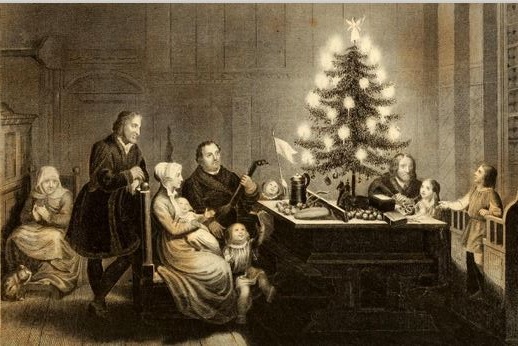
Devout Christians of sixteenth century Germany began trying to outdo the rest of Europe with their usual humorless Teutonic ambition. Instead of hanging a few little evergreen boughs about the hearth at Christmastime, they began hauling whole trees into their homes. According to legend, Martin Luther himself was walking home from a sermon one night when he was struck by the beauty of the glittering stars among the pines. When he got home he promptly decorated his own tree with candles. Despite the obvious fire hazard, this quickly became a popular tradition.
After the Reformation, puritans decided there was too much eating, drinking, and fornication associated with Christmas and that it was therefore bad. Many rulers outlawed it altogether. This was not usually popular: in England, for example, Oliver Cromwell cancelled Christmas, resulting in the restoration of Charles II and the retaliatory cancellation of Mr. Cromwell's head.
All of this was bad for Christmas, but such was St. Nicholas' popularity that it did little to deter from his reputation. He remained on top of the charts. Nowhere was he more popular than in Holland, where he was venerated as Sint Nikolaas, or more familiarly as Sinter Klaas.
The puritan bastards who settled America avoided Christmas as part and parcel of their longstanding commitment to No Fun. Massachusetts Colony actually penalized anyone caught celebrating Christmas with a five-shilling fine. Since it was considered an English holiday, it was ostentatiously ignored in the years during and after the Revolution, and wasn't made a federal holiday until after the Civil War (on June 26, 1870.)
Washington Irving had done his part in sorting through barbarian superstitions for things that were wholesome, pleasant, and commercial enough to be made officially American, and in 1809 he referred to St. Nicholas as the Patron Saint of New York. In 1822 an Episcopalian minister named Clement Clarke Moore wrote a frivolous poem for his daughters entitled "A Visit from St. Nicholas." Mr. Moore cleverly ignored all elements of the good saint's biography involving slavery, prostitution, dowries, and sailors. He focused instead on sleighs, reindeer, and presents for good little American boys and girls. It was so silly and frivolous that it became one of the most popular American poems ever—second only to the one about the guy from Nantucket.
By 1820, American stores had begun to advertise Christmas shopping, and by 1870 children were flocking to Macy's to see Santa Claus. And so it was that America began applying its curious collective genius for assimilation to the vast storehouse of silly and primitive traditions from throughout the world.
Thus we need not concern ourselves with St. Lucia, the patron saint of the blind, whom Scandinavians honor each December 23 (Little Yule) with elaborate pagan rituals involving candles, torches, and bonfires.
We need not worry about the witch Babouschka, who visits Russian children with gifts each Christmas to compensate for a nasty little joke she once played on the wise men,
or the Italian witch La Befana.
We need not trouble ourselves with the construction of piñatas each holiday season, as Mexican parents must.
We don't have to sit around our tables as they do in Ukraine, waiting for the evening star to appear before we begin our meal. We need not fear the kallikantzeri of Greece, nasty little goblins that cause mischief for the twelve days of Christmas.
And let's not even talk about Krampus
Let's all take a moment during these troubled times to express our gratitude and admiration for our American traditions, which are so much better than the traditions of every other country.
I wish to all you gentle readers, a happy, healthy and joyous holiday.
December 24, 1940 - George Cukor's classic film-comedy The Philadelphia Story, starring Cary Grant and Katherine Hepburn, premiered on this date.
Cary Grant demanded top billing and $100,000 salary--a huge amount at the time. As it turned out, however, he donated his entire earnings to the British War Relief Fund.
December 24, 1951 - Gian Carlo Menotti'sAmahl and the Night Visitors became a Christmas classic on this date.
The one surviving kinescope of this first production was thought to have been lost forever, accidentally destroyed by someone at NBC after it had been screened for an executive, but another copy was discovered at the Museum of Radio and Television, in New York.
December 24, 1953 - Jack Webb's series Dragnet aired a special episode, The Big Little Jesus on this date.
The episode was network television's first half-hour color film. It was the only color show of the series. Those of you with very sharp eyes can tell with some prompting that this is not the color episode.
Sorry about that.
Today in History: December 24, 1818 -
The classic Christmas carol, Silent Night, was first performed on this date.
At St. Nicholas Church in Oberndorff, Austria, Franz Gruber, composed on his guitar the melody for Silent Night. The music was combined with the words from Joseph Mohr's poem, Stille Nacht.
December 24, 1826 -
On hearing that their Christmas celebrations had to be alcohol-free, several West Point cadets smuggled in a few jugs of whiskey. Their private party got out of hand, and the ensuing melee became known as The "Eggnog Riot".
Shots were fired, and an artillery unit had to be called in to calm things down. Among the participants was future President of the Confederacy Jefferson Davis.
December 24, 1865 -
Southern white folks united together to form a service organization wherein they consort with other southern white folks on this date.
Members participate in festive cruciform fire ceremonies and lively negro butcherings.
By the 1920s membership in the Ku Klux Klan reaches an astonishing two million.
December 24, 1867 -
This was the first time that the R.H. Macy's department store in New York City remained open until midnight to catch last-minute shoppers.
Things never change.
December 24, 1914 - World War I was only months old on Christmas Eve 1914 when an extraordinary unofficial truce occurred in many places along the Western Front. "We were all moved and felt quite melancholy," wrote one German soldier, "each of us taken up with his own thoughts of home." German and English troops, often less than one hundred yards from each other, set aside warfare to trade Christmas greetings and sing familiar carols in two languages (If you remember correctly, most of the major players in this war were more than just on a first name basis - they were all related to a minor German prince who happened to be married to his cousin, the Queen of England.)
The truce, probably observed by two-thirds of the British and German troops, ended with the holiday, but reasserted the basic decency of ordinary men like these British and German soldiers caught up in war.
December 24, 1954 -
Rock musician Johnny Ace plays a little .45 calibre solitaire (Russian Roulette) at City Auditorium in Houston after a concert.
Blammo.
He thought it would impress his girlfriend - perhaps it did.
December 24, 1968 - Apollo VIII astronauts read passages from the Old Testament Book of Genesis and transmitting a message to all mankind calling for 'peace on earth', during a Christmas Eve television broadcast. The three astronauts, James A. Lovell, William Anders and Frank Borman (our friend with the messy space suit,) had reached the Moon.
They would orbit the moon ten times, paving the way for the first Earthling to walk on the lunar surface some seven months down the road .
December 24, 1985 - Fidel Castro announced that he has given up cigars on this date.
Santa finally sent Krampus his way this year.
You'd better hurry up and finish your shopping before I start explaining how the War of 1812 was resolved by the Treaty of Ghenet on this date in 1814 and yet the Battle of New Orleans took place on January 8, 1815, after the treaty was signed.
And so it goes.
Smithers, do you hear what I hear? Christmas is but a day away.
As not to embarrass yourself tonight at your Festivus family gathering, here are the four tenets of the holiday:
The Festivus Pole: During Festivus, an unadorned aluminum pole is displayed. The pole was chosen apparently in opposition to the commercialization of highly decorated Christmas trees, because it is "very low-maintenance," and also because the holiday's patron, Frank Costanza, "find[s] tinsel distracting."
Festivus Dinner: The Festivus dinner menu is flexible, but it should consist of filling, non-holiday comfort food (no turkey, duck, goose, or ham). The televised dinner featured what may have been meatloaf or spaghetti in a red sauce. (Presumably, an entree in a red sauce is more festive.) Kruger took a flask out from his jacket and took a swig; so one might interpret that drinking is optional.
The Airing of Grievances: At the Festivus dinner, each participant tells friends and family of all the instances where they disappointed him or her that year.
The Feats of Strength: The head of the family tests his or her strength against one participant of the head's choosing. Festivus is not considered over until the head of the family has been pinned to the ground. A participant is allowed to decline to attempt to pin the head of the family only if they have something better to do instead.
Don't forgot to keep your eye out for the Festivus Miracle. A Festivus Miracle is a frequent if unimpressive miracle. Carrying in all the groceries into the house for Festivus Dinner without tripping or dropping one of the bags could be considered a Festivus Miracle.
A Healthy and Happy Festivus to you and your family.
December 23, 1942 -
The Noel Coward-David Lean War time drama, In Which We Serve, premiered in the US on this date.
Noël Coward was a friend of Lord Louis Mountbatten, who was Captain of the Royal Navy destroyer HMS Kelly from the outbreak of the Second World War until Kelly was sunk by enemy action in May, 1941. Coward wrote the screenplay for this movie based on Mountbatten's experiences on HMS Kelly. Coward's character in the film, Captain E. V. Kinross R.N. / Captain 'D', was also based on Mountbatten's experiences. December 23, 1954 - Walt Disney's live-action film, 20,000 Leagues Under the Sea, premiered on this date.
The climactic squid battle on the Nautilus was originally shot with a serene sunset and a calm sea. Director Richard Fleischer was troubled by the look of it because the cams and gears that operated the squid could easily be seen, making it look obviously fake. Walt Disney visited the set one day and Fleischer told him about the problem. Disney came up with the idea of having the squid battle take place during a fierce storm (another story is that it was actually screenwriter Earl Felton who came up with the idea). The scene was reshot that way and is considered by many to be the highlight of the film. .
December 23, 1956 - Alfred Hitchcock's classic quasi-docudrama, The Wrong Man, starring Henry Fonda, Anthony Quayle and Vera Miles, opened in Los Angeles, on this date.
The scene where Henry Fonda is taken to prison was filmed in a real prison. As he is led to his cell , you can hear one of the inmates yell out "What'd they get ya for, Henry??", and a bunch of other prisoners laughing.
Today in History: December 23, 1690 -
Royal British astronomer John Flamsteed made the first sighting of Uranus by an astronomer on this date. Unfortunately, he didn't know what he was looking at, and classified it as a star: so yes, he didn't know Uranus from a star (I couldn't help myself.)
The 7th planet – Uranus – was 'officially' discovered on March 13, 1781, once again, completely by accident. British astronomer William Herschel was performing a survey of all the stars that were of magnitude 8 (too faint to see with the eye – or brighter.) He noticed an object that moved in front of the star background over time, clearly demonstrating it was closer to us than the distant stars. At first he thought he had found a comet, but later realized this object was a new planet in orbit around the sun.
December 23, 1750 - Benjamin Franklin was severely shocked while electrocuting a turkey on this date. Franklin believed electrocuting the turkey would make it more tender.
Lost in the annals of history is the crime the fowl committed.
December 23, 1823 -
The famous poem A Visit From St. Nicholas was first published on this date. It begins, Twas the night before Christmas, when all through the house / Not a creature was stirring, not even a mouse ....
Fourteen years after its first publication, an editor attributed the poem to a wealthy professor of classical literature named Clement Clarke Moore.
In the last few years, new evidence has come out that a Revolutionary War major named Henry Livingston Jr. may have been the actual author of The Night Before Christmas.
His family has letters describing his recitation of the poem before it was originally published, and literary scholars have found many similarities between his work and The Night Before Christmas. He was also three quarters Dutch, and many of the details in the poem, including names of the reindeer, have Dutch origins.
December 23, 1888 -
After an argument with fellow painter Paul Gauguin, Vincent van Gogh took a razor and removes a portion of his left ear. Their quarrel regarded the prostitutes in Arles who seemed to prefer Gauguin over Van Gogh; the painter delivered his ear a startled prostitute. She fainted.
Some women get very emotional when they receive that special gift.
December 23, 1938 -
The Coelacanth is one of the oldest living fish, and was thought to have gone extinct some 60 million years before Captain Hendrick Goosen caught one off the coast of South Africa on this date.
Since that time, more than 200 Coelacanths have been caught. It is one of the textbook examples of a "living fossil."
December 23, 1948 -
Japanese Premier Tojo and six others were hanged by the War Crimes Commission at Sugamo Prison, Tokyo, for the crime of starting an aggressive war on this date.
Now, that's not a necktie you want for Christmas.
December 23, 1968 -
On the first day of the first flight ever by astronauts to orbit the Moon, Apollo 8 commander Frank Borman suffers from the first documented case of motion sickness. Previous astronauts had reported nothing -- partly because their ships were too small for them to move around a lot and get queasy, partly because they kept their mouths shut for fear they'd never fly again.
There is nothing worse than barfing into your own spacesuit.
Oh, wait a minute, yes there is - barfing into someone else's spacesuit.
December 23, 1985 -
In a Lutheran school playground, James Vance and Raymond Belknap acted upon a drunken suicide pact forged while listening to Stained Class by Judas Priest. Belknap shot a 12 gauge shotgun under his chin, dying instantly, and Vance followed, but survived with a severely disfigured face. He later dies from painkillers on Thanksgiving three years later. Both kids' parents file suit against the band, but a judge ultimately rejects their subliminal message theory.
I believe anyone would kill themselves being forced to listen to Judas Priest, but that's just me.
December 22, 1932 - Universal Pictures released the horror film The Mummy, directed by Karl Freund and starring Boris Karloff on this date.
Boris Karloff's mummy makeup is based on the appearance of Ramses III; makeup artist Jack P. Pierce spent eight hours a day applying Karloff's makeup.
December 22, 1944 - The Mummy's Curse, the follow-up film to The Mummy's Ghost was released by Universal Pictures on this date.
The flashback sequence features footage of Boris Karloff and Tom Tyler from earlier films--thus Kharis is actually played by three different actors (more if stunt doubles are included).
December 22, 1949 -
The film version of Maxwell Anderson's play (Joan of Lorraine,) Joan of Arc, starring Ingrid Bergman opened in Los Angeles on this date.
According to some biographies of Ingrid Bergman, Howard Hughes saved her from possible injury during a visit to the set when she fell off her horse. He caught her, but rather awkwardly, with one hand firmly on her crotch. Shades of Donald Trump...
December 22, 1959 - Joseph L. Mankiewicz' film version of Tennesse Williams' strange one act play (about rape, incest, homosexuality, and cannibalism - I know that was probably a huge selling point,) Suddenly, Last Summer, premiered on this date.
Because of years of alcoholism and prescription drug abuse, Montgomery Clift was considered uninsurable due to chronic ill health. Ordinarily that would have meant he would have been fired and replaced, but his good friend Elizabeth Taylor saved his job by insisting she would not do the film without him.
December 22, 1965 - David Lean's Russian epic, Dr Zhivago, premiered in the US, on this date.
The film was not shown in Russia until 1994.
December 22, 1975 -
A beautiful study of love and madness (and the razor's edge between them), L'histoire d'Adele H, opened in the US on this date.
Initially planned as a grand-scale spectacular drama with Jeanne Moreau to play the lead, then Catherine Deneuve (then having an affair with François Truffaut) was considered for the role. The film took seven years to be made, and finally Truffaut decided on Isabelle Adjani whom he noticed on a TV broadcast of the Comédie Française.
Today in History: December 22, 1879 -
It's Stalin's birthday (again)! Hey, when you're a dictator, you get to celebrate your birthday on more than one day. Unfortunately, the proper way to celebrate - oppress, torture and murder millions of your fellow country men - is frowned upon.
So smack someone upside the head for no reason.
December 22, 1937 -
The center tube of the Lincoln Tunnel was opened to traffic today, charging $0.50 per passenger car.
Some of those cars are still trying to get through the tunnel.
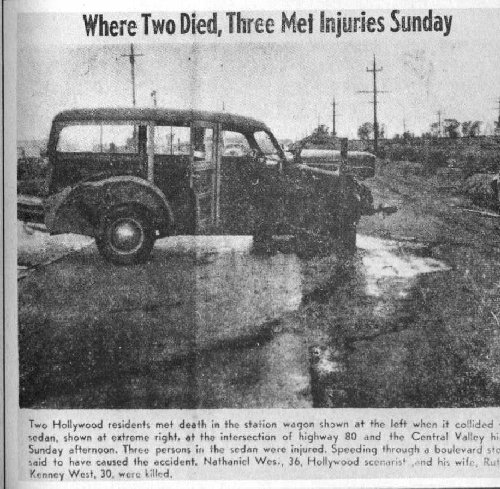
December 22, 1940 - Strange death of the day - Author Nathanael West and his wife, Eileen McKenney, died in an auto accident on this date.
Distraught over hearing of his friend's F. Scott Fitzgerald's death (who passed away a few days earlier of a massive heart attack,) he crashed his car after ignoring a stop sign.
December 22, 1955 -
The corpse of Evita Peron was stolen by anti-Peronistas on this date. For 26 years, her corpse makes a world-wind turn before it's returned for burial in Buenos Aires.
30 years later (to the day), Madonna's Like a Virgin single goes #1 for weeks.
Make of the coincidence what you will.
December 22, 1984 - Bernhard Goetz shot four teenage boys on the NYC subway after one of them asks him for money.
Again, this practice is frowned upon, so instead, smack someone upside the head.
December 22, 2001 - Richard Reid attempted to blow up an American Airlines transatlantic flight by igniting a plastic explosive concealed in his shoe. Other passengers beat the living daylights out of him.
The Winter Solstice in Northern Hemisphere will be at 5:44 AM (EST), the shortest day of the year and the longest night.
It's officially the first day of Winter and one of the oldest known holidays in human history.
Anthropologists believe that solstice celebrations go back at least 30,000 years, before humans even began farming on a large scale. The stone circles of Stonehenge were arranged to receive the first rays of midwinter sun.
It is therefore a good time to do things you wouldn't want the sun to hear about. The Pagans, for example, wisely celebrate their Yule holiday on the Winter Solstice.
Ancient peoples believed that because daylight was waning, it might go away forever, so they lit huge bonfires to tempt the sun to come back. The tradition of decorating our houses and our trees with lights at this time of year is passed down from those ancient bonfires.
In Ancient Rome, the winter solstice was celebrated with the festival of Saturnalia,
during which all business transactions and even war were suspended, and slaves were waited upon by their masters.
Hey, Get Naked, Paint Yourself Blue and Dance around the Fir Tree. It's party time!!!
December 21, 1914 -
The first feature-length silent film comedy, Tillie's Punctured Romance, starring Marie Dressler, Charlie Chaplin and Mabel Normand, was released on this date.
This film marked the last time that Charles Chaplin would be directed by someone other than himself.
December 21, 1932 -
The movie musical Flying Down to Rio premiered on this date.
Originally conceived by RKO as a vehicle for Dolores del Rio, this film is most notable for its star-making pairing of Fred Astaire and Ginger Rogers. The two relative unknowns smoked up the screen in a dance number called The Carioca that generated such a positive response form critics and fans that they were eventually reunited in nine subsequent films.
December 21, 1937 -
The first feature-length color and sound cartoon, Walt Disney’s Snow White and the Seven Dwarfs, premiered on this date.
The animation took over two years and a then astronomical $1.5 million to create. Disney had to mortgage his house to pay for the film's production.
December 21, 1940 - Hot?! Who's afraid of hot?
Another classic Porky Pig cartoon, The Timid Toreador, premiered on this date.
December 21, 1959 -
The Orpheus legend set in Rio de Janeiro (with the fabulous music by Luiz Bonfa and Antonio Carlos Jobim,) Black Orpheus, premiered in the US on this date.
Although the film won the Palme d'Or at Cannes and the Oscar for Best Foreign Language Film, ironically it is not terribly well regarded in its native Brazil where some object to the depiction of their country as being a non-stop party.
December 21, 1963 - The Doctor Who story arc The Daleks, the second story of Season One, first aired on the BBC on this date.
The episodes mark the first appearance of the Doctor’s mortal enemies, the Daleks, a race of genetically engineered mutants who abhor all other races.
December 21, 1969 - Diana Ross and the Supremes make their final television appearance on The Ed Sullivan Show, on this date.
The song they sang, Someday We'll Be Together, would become the last of their 12 number one singles.
Today in History -
The pilgrims landed on Plymouth Rock on December 21, 1620 or some other day, the pilgrims were too busy depriving themselves of luxuries like accurate calendars (Their stepping ashore onto a large rock that later became known as the Plymouth Rock probably is a myth.) Their boat was the Mayflower.
They wore black and white clothes with big shiny buckles.
The crew of the ship did not have enough beer to get to Virginia and back to England so they dropped the Pilgrims at Plymouth Rock to preserve their beer stock.
December 21, 1879 - Josif Djugashvili was born in the Gori District of Tiflis Province in Georgia, Imperial Russia, on this date.
(or December 18th or the 22nd. When you're an evil bastard dictator, you get to choose your own birthday).
December 21, 1898 - Radium, which existed since the world was young, was minding it own business when French local busybodies and known chemists Pierre and Marie Curie isolated radium; one of the first radioactive elements to be discovered. They won a joint Nobel prize for their work, and Marie Curie went on to win another for her contributions to chemistry.
Marie Curie died of aplastic anemia as a result of overexposure to radium, which probably showed her not to play with radioactive elements.
December 21, 1940 - You can't live forever; you can't live forever. ...
F. Scott Fitzgerald, died of a heart attack at Sheilah Graham's apartment on this date. He was 44 and believed he had died a failure.
And yet, into the 21st century, millions of copies of his works have continued to be sold.
December 21, 1945 - World War II General George Patton died in a car accident in Heidelberg, Germany on this date.
Patton was investigating the theft of Nazi gold by US Army men at the time. My grandfather was convinced that it was a conspiracy and he was killed by the men he was investigating.
My grandfather was a small time numbers runner but that's another story ...
December 21, 1968 - Apollo 8 was the second manned mission of the Apollo space program, in which Commander Frank Borman, Command Module Pilot James Lovell and Lunar Module Pilot William Anders became the first humans to leave Earth orbit and to orbit around the Moon.
The spacecraft entered into orbit around the moon on December 24th. They were the first men to ever view the Earth in its entirety, with them taking photos of our planet whilst on board the spacecraft and sending them back to television stations back home. They landed back on Earth on December 27th.
A year later Apollo 11 would be the first manned spacecraft to land on the Moon.
December 21, 1970 -
Paranoid, alcoholic President Richard Nixon met with prescription drug addict Elvis Presley at the White House to discuss The King's becoming a special drug enforcement agent.
He presented Nixon with a pistol, and received a special DEA badge in return.
December 21, 2012 - We're still here!
The Mayan "long count" calendar is based on great cycles of 5125 years; apparently, the world has not ended.
Before you go, James Corden has unveiled a Christmas special of Carpool Karaoke.
Can we all wish that Mariah discovers the joys of foundation garments this Christmas?
Remember stores will be packed with last minute shoppers,
clawing their way through the remaining unadorned aluminum pole displays.
December 20, 1946 -
The Frank Capra film It's A Wonderful Life had a preview showing for charity at New York City's Globe Theatre, a day before its official premiere.
As Uncle Billy drunkenly leaves the Bailey home, it sounds as if he stumbles into some trash cans on the sidewalk. In fact, a crew member dropped a large tray of props right after actor Thomas Mitchell went off-screen. In reaction, James Stewart began laughing and Mitchell quickly improvised "I'm alright, I'm okay!". Director Frank Capra decided to use this take in the final cut.
Next time you get a chance to watch the film, notice what a truly strange little film it really is.
December 20, 1961 - Columbia Pictures releases the science fiction film Mysterious Island, directed by Cy Endfield and featuring the stop-motion animation of Ray Harryhausen, on this date.
Producer Charles H. Schneer claimed that he chose this story after reading an article stating that Jules Verne'sMysterious Island was the most-looked-at book at public libraries.
December 20, 1967 - Mike Nichols' seminal 60s film, The Graduate, starring Dustin Hoffman and Anne Bancroft, premiered on this date.
Although Mrs.Robinson is supposed to be much older than Benjamin, Anne Bancroft and Dustin Hoffman are just under six years apart in age. He looked naturally boyish, and she was made up to look older. For the same reason, Bancroft was only 8 years older than her "daughter" Katharine Ross, William Daniels (Mr. Braddock) only 10 years older than his "son" Hoffman.
December 20, 1971 - Hal Ashby's very dark comedy, Harold and Maude, starring Ruth Gordon and Burt Cort, premiered on this date. The film was not a commercial success when it opened but is now seen as one of the most influential films of the 1970s.
Bud Cort was hoping that Greta Garbo would play the part of Maude.
December 20, 1979 - Bob Fosse’s semi-autobiographical film All that Jazz, starring Roy Scheider, Ann Reinking, Jessica Lange and Ben Vereen, opened in the US on this date.
Richard Dreyfuss was originally cast in the role of Joe Gideon but left the production during the rehearsal stage, citing a lack of confidence in the production. He later admitted that he made a mistake in passing up the chance to work with Bob Fosse.
December 20, 2002 - Martin Scorsese take on the notorious Five Points district of Lower Manhattan during the mid 19th century, Gangs of New York, starring Leonardo DiCaprio, Daniel Day-Lewis and Cameron Diaz, was released on this date.
Daniel Day-Lewis became so uncomfortable with the greasy hairstyle he wore as Bill the Butcher that he shaved his head immediately after filming completed.
Today in History December 20, 1803 -
France finalized the Louisiana Purchase and transferred authority over the region to the United States, as a Christmas gift for Thomas Jefferson on this date.
The wisdom of this purchase was not fully appreciated at first but after Mardi Gras it was warmly embraced.
(It was not for nothing that Thomas Jefferson collected beads.)
December 20, 1879 -
Thomas Edison privately demonstrated light bulb to a rapt audience on this date at Menlo Park, N.J.
Unfortunately, it took 27 of his assistants to lift the entire shed and turn it around to screw in the bulb and many believe the light would never take off.
December 20, 1892 -
According to Jules Verne, on October 2nd, Phileas Fogg stepped out of the Explorers Club in London, England and decides to take a little trip.
Due to the incompetence and laziness of most of the transit workers around the world, finally completed his trip on this date.
Adolf Hitler was released from prison on December 20, 1924, after serving less than a year against a five-year treason sentence. Hitler became a prolific author while in prison, where he penned the infamous political autobiography Mein Kampf. (How I Intend to Enslave or Kill Millions of People Immediately Upon My Release.)
He also outlined a series of children’s books which have sadly been lost to history as a result of his having chosen upon his release to pursue a path of demonic world conquest instead of pedagogical literature. One can only wonder what sort of success Hitler would have experienced with titles such as:
Make Way for Stormtroopers,
Driving Gypsies and Jews Up A Tree,
Every Little Aryan Child’s Bedtime Book of Insidious Evil and Global Domination.
December 20, 1941 - The Flying Tigers, American pilots in China, entered combat against the Japanese over Kunming on this date.
The group, formed 12 days after Pearl Harbor, was a great morale booster, as it posted numerous tactical victories when the news in the U.S. was filled with little more than stories of defeat at the hands of the Japanese forces.
December 20, 1957 - Elvis receives orders from the draft board to serve in the United States Army, which to his credit he does without complaint.
I should have prepared you for the sight of Elvis in his civvies.
December 20, 1997 - Sotheby's auctioned off the loincloth worn by Kirk Douglas in the 1960 film Spartacus for $2,990 on this date.
You can't get those at Robert Hall, aisle five.
December 20, 2007 - Elizabeth II turned 81 years and 243 days old on this date and surpassed Queen Victoria as the oldest UK monarch.
Buckingham palace had the time calculated down to the hour, though no major celebrations were held to mark the occasion. About a year ago, the Queen became the longest reigning sovereign and Prince Charles has been officially pissed since that date.
December 19, 1961 -
Released in time for the holidays, the star-studded Stanley Kramer film, Judgment At Nuremberg, opened in New York City on this date.
Maximilian Schell's Oscar for Best Actor makes him the lowest-billed lead category winner in history. He is billed fifth, after Spencer Tracy, Burt Lancaster, Richard Widmark and Marlene Dietrich.
December 19, 1971 -
The pilot for the hit family series The Waltons, The Homecoming: A Christmas Story premiered on CBS-TV on this date
Actresses Josephine Hutchinson and Dorothy Stickney, who portrayed the elderly Baldwin sisters, passed away within two days of each other in 1998, 27 years after this film was made.
December 19, 1971 - A Clockwork Orange premiered on this date, originally with an X rating. Censors objected more to the sex scenes than the violence.
The snake, Basil, was introduced into the film by Stanley Kubrick when he found out Malcolm McDowell had a fear of reptiles. This was to make McDowell's character seem more intimidating, and as a practical joke by Kubrick.
December 19, 1997 -
The movie, Titanic was released in theaters on this date. This movie would become the most financially successful movie in U.S. history, grossing approximately $1.8 billion worldwide (until the release of Avatar in 2009, which grossed an astounding $2.075 billion. Avatar was conveniently directed by Mr. Cameron as well.)
After finding out that she had to be naked in front of Leonardo DiCaprio, Kate Winslet decided to break the ice, and when they first met, she flashed him.
December 19, 2001 - New Line Cinema released the The Lord of the Rings: The Fellowship of the Ring (based on the epic 1954 novel by J.R.R. Tolkien,) directed by Peter Jackson and starring a very large number of people, premiered in the U.S. on this date.
Gandalf's painful encounter with a ceiling beam in Bilbo's hobbit-hole was not in the script - Ian McKellen banged his forehead against the beam accidentally, not on purpose. Peter Jackson thought McKellen did a great job "acting through" the mistake, and so kept it in.
Today in History: December 19, 1154 - Henry was 18 when we met and I was queen of France ... We shattered the commandments on the spot.
Henry Plantagenet of the Angevin dynasty was crowned Henry II, King of England with Eleanor of Aquitaine as queen, on this date.
December 19, 1733 - Benjamin Franklin, writing under the pseudonym of Poor Richard, published Poor Richard's Almanack on this date.
The book, filled with proverbs and parables, was published continuously for 25 years and became one of the most popular publications in colonial America, selling an average of 10,000 copies a year.
December 19, 1777 - These are the times that try men's souls.
General George Washington led his ragtag army of about 11,000 men to Valley Forge, Pa., to camp for the winter on this date.
December 19, 1903 -
On this date, the Williamsburg Bridge was opened in New York City. It was America's first major suspension bridge using steel towers instead of the customary masonry towers.
It was built to alleviate traffic on the Brooklyn Bridge and to provide a link between Manhattan and the Williamsburg section of Brooklyn. Taking over seven years to complete, the 1,600 foot Williamsburg Bridge was the world's longest suspension bridge until the 1920s.
December 19, 1922 -
In a Sheffield, England, courtroom, accused bigamist Theresa Vaughn admitted under oath that in the past five years she had acquired 61 husbands in 50 cities throughout England, Germany and South Africa, averaging a marriage a month.
And you think you've been busy.
December 19, 1928 -
The first autogyro flight in the U.S., piloted by H.F. Pitcairn, was made on this date.
The autogyro would later lead to the development of the helicopter.
December 19, 1941 - Twelve days after Pearl Harbor, Franklin D. Roosevelt under authority of Congress, created the Office of Censorship. The bureau had discretion over communications with foreign countries. Participation by domestic publishers was "voluntary."
From December 1941 to August 1945, every letter that crossed international or U.S. territorial borders was subject to being opened and reviewed for details.
Sounds a little familiar.
December 19, 1972 - Apollo 17 completed their mission and splashed down in the Pacific on this date.
With this return to earth, the Apollo program of manned lunar landings ended.
December 19, 1974 - Nelson A. Rockefeller was sworn in as the 41st vice president of the United States after a House vote. Rockefeller was the second person appointed Vice President under the 25th Amendment – the first being Gerald Ford (the man for whom he was serving as Vice President.)
After the proceedings, Rockefeller celebrates by copulating vigorously with three of his assistants in the Warren G. Harding memorial cloakroom.