Read the ramblings of Dr. Caligari. Hopefully you will find that Time does wound all heels.
You no longer need to be sad that nowadays there is so little useless information.
A great animated film, Pigeon: Impossible (directed by Lucas Martell)
Show it to everybody you know (don't spoil the ending.)
November 10, 1969 - Come and play. Even at 40, everything's A-OK.
"Sesame Street" premiered on PBS TV on this date.
(I think this is one of the funniest interviews of anyone on TV.)
Today in History November 10, 4004 BC - Adam and Eve are driven from Paradise.
So if you feel some uneasy shame about your genitals today, you know why.
November 10, 1871 - New York Newspaperman Henry M. Stanley finally found Scottish explorer Dr. Livingstone at Ujiji near Lake Tanganyika (helpfully identified by some sources as being "near Unyanyembe"), and remarked, "Dr. Livingstone, I presume?", on this date.
This was extremely witty and therefore historical.
November 10, 1928 - Playing against Army at Yankee Stadium, Notre Dame football coach Knute Rockne gives what is considered the greatest locker room speeches of all time by saying "Win one for the Gipper."
The Fighting Irish would win the game 12-6.
November 10, 1928 - Michinomiya Hirohito is crowned the 124th Emperor of Japan, Emperor Showa.
Sometimes, it's not so good to be the king.
November 10, 1940 - Walt Disney begins serving as a secret informer for the Los Angeles office of the FBI, to report back information on Hollywood subversives. He was made a "Full Special Agent in Charge Contact" in 1954.
We should note that Disney was also atheist, Neo-Nazi, racist and possible child pornography collector, thus subversive in his own little way.
November 10, 1975 - The 729-foot-long freighter SS Edmund Fitzgerald sinks during a storm on Lake Superior, killing all 29 crew on board
and unfortunately is the subject of Gordon Lightfoot's annoying hit song, "The Wreck Of The Edmund Fitzgerald."
Long-standing controversy exists between this film and the Tom & Jerry short, The Cat Concerto (1946).
Both sides (WB & MGM) claim that theirs was the original, and the other was a rip-off. Nobody knows for sure who is correct and it is, of course, entirely conceivable that the similarities are pure coincidence.
November 9, 1951 - The zenith of Hollywood Musical film making (I'll let you argue about with this or Singing in the Rain is better), An American in Paris, opened in California on this date.
The 17-minute dance sequence at the end took a month to film. It cost half a million dollars.
November 9, 1964 - Another underappreciated film that you should see, The Pumpkin Eater, opened in the US on this date.
This film will remind you what a phenomenal actor Anne Bancroft was.
Today's word - Aretaloger: noun, braggart; one who boasts about his own accomplishments. While he seemed nice at first, he turned out to be a loudmouthed aretaloger.
Your History Today - It was 20 years ago today ...
Duyba, in 2001, declared this date to commemorate the fall of the Berlin Wall and the liberation of Central and Eastern Europe from communism.
The French are still casting a leery eye at their reunified neighbor.
November 9, 1906 - Teddy Roosevelt went against more than a century of tradition and became the first American president ever to leave the country while in office, on this date. He went to view the construction site of the Panama Canal.
Before Roosevelt, it was assumed that a President of the United States couldn't oversee the country effectively if he traveled abroad. It would take too long for him to communicate with government officials back home. But with the invention of the telegraph and then the telephone, high speed communication had grown much more feasible.
So on this day in 1906, Roosevelt and his wife climbed aboard the U.S.S. Louisiana and sailed south. The journey to Panama made Roosevelt happier than he'd been in a long while. He strolled the decks with his wife, read a stack of books he'd brought with him, including Tacitus and Milton, and the captain even let him steer the ship at one point. When he got to Panama itself, he was so impressed by the jungle and the tropical wildlife that he didn't even mind the torrential rains.
The chief engineer had the incredibly difficult task of accompanying Roosevelt everywhere he went. He said, "I have blisters on both feet and am worn out…Scaling a hill with Roosevelt is like taking a fort by storm." They took a train to the construction site, but when Roosevelt saw the first 95-ton steam shovel, he ordered that the train be stopped so that he could hike through the mud to see the steam shovel up close. It was a new invention at the time, and Roosevelt spent a half an hour asking about its operation. He then took a turn at the controls.
Although, King Louis (Mel Brooks) said, "It's good to be the king", it must have been a blast to be Teddy. Bully, bully.
November 9, 1953 -
Dylan Thomas drinks himself to death, at the White Horse Tavern, in Greenwich Village, Manhattan, .
Sometimes it is not good to be a drunken Welsh poet.
November 9, 1965 - The Northeast Blackout of 1965 was a major power outage affecting Canada and Connecticut, Massachusetts, New Hampshire, Rhode Island, Vermont, New York, and New Jersey in the United States.
Around 25 million people and 80,000 square miles were left without electricity for up to twelve hours. Although human error was the official blame, there is another theory that UFO's visiting the Northeast were to blame.
Who knows?
November 9, 1967 - First issue of Rolling Stone Magazine is published.
November 9, 2346 - Romulans commit an atrocity now known as the Khitomer Massacre, slaughtering over 4,000 Klingons on an agricultural colony.
November 8, 1971 - Led Zepellin released their untitled fourth album, containing the hits "Black Dog", "Rock and Roll", "Stairway to Heaven", "Misty Mountain Hop", "Going to California", and "When the Levee Breaks", on this date.
And kids remember, according to the Consumer Protection and Toxic Materials Committee of the California State Assembly, if you play "Stairway to Heaven" backwards, you can hear:
Oh here's to my sweet Satan. The one whose little path would make me sad, whose power is Satan. He will give those with him 666. There was a little tool shed where he made us suffer, sad Satan.
So, don't play you albums backwards (many of you have no idea what albums are.)
November 8, 1431 - Vlad III the Impaler (Vlad Dracula), Transyvanian prince, inspiring the name of the vampire in Bram Stoker's 1897 novel Dracula, died on this date.
November 8, 1954 Rickie Lee Jones, two-time Grammy Award-winning vocalist, musician, songwriter and producer, was born on this date.
November 8, 1994 - Michael O'Donoghue writer for National Lampoon magazine, and was the first head writer Saturday Night Live died of a cerebral hemorrhage at age 54, after a long history of what were thought to be chronic migraine headaches.
Word of the day- Brephophagist: noun, one who eats babies. His shouts of "Into my belly" while chasing the toddlers at first seemed cute, then they revealed Fat Bastard's true nature: a disgustingly obese Scottish brephophagist.
Today in History - On November 8, 1923, a general assembly of the Bavarian government began a meeting at a Munich beer hall at approximately 8:00 pm. At about 8:45 pm, the meeting was disrupted by a man in "a baggy, black suit that made him look like a waiter." The man leaped onto a table, fired a couple of shots into the ceiling, then forced his way onto the platform.
"The national revolution has begun!" he shouted.
Having gained everyone's attention, the strange little man announced that six hundred of his own men had the beer hall surrounded (they didn't), that the national and Bavarian governments had been taken (they hadn't), that the military and police barracks had been occupied (they weren't), and that he'd like a word or two in private with the three Bavarian leaders on the platform if it wouldn't be too inconvenient (it wasn't).
Once in a private room, the stranger informed the trio that he'd welcome their participation in his new government. They expressed no interest. He waved his revolver in their faces, but still they demurred. He held the pistol to his own head, then realized this wasn't very persuasive and simply returned to the general hall to announce that the leaders were behind him.
A little later, a prominent Bavarian general arrived at the beer hall and announced his support for the stranger. At this point the three leaders were released from their private room, and they too were suddenly in support of the little stranger. Feeling pretty swell about all this support, the stranger left the beer hall briefly to quell a dispute among some of his men outside the hall.
By the time he returned, he found that the three leaders had left the beer hall and were hastily making the rounds in Munich, retracting what they'd been forced to say. The stranger became apoplectic. He and the Bavarian general then came up with a contingency plan: they would gather some men and storm the government the following morning, November 9.
And so they did. Eighteen of their followers and four Bavarian policemen were killed in the conflict. Two days later, the stranger was arrested at the home of a friend, where he'd been hiding. Ten years later, the evil wingnut bastard was elected Chancellor of Germany.
The Milk Chocolate with Almonds people are protesting
November 7, 1955 - The neo-realist film classic, Umberto D., was released in the US on this date.
Watch it and have a good cry
November 7, 1956 - An early masterpiece from Fellini, I Vitelloni, wsas released in the US on this date.
If you haven't seen this autobiographical work, run out and grab it.
November 7, 1963 - The comedy that features one of the largest collections of American comedians ever brought together, It's a Mad Mad Mad Mad World, premiered on this date.
While I find this films parts are greater that the whole, it holds a special place in my family's heart - my father supposedly laughed so hard watching it that he fell out of his aisle seat in the movie theatre.
Here is your daily dose of Today in History: Maria Sklodowski was born in Warsaw, Poland, on November 7, 1867. Poland was controlled by Russia at the time, so Maria was referred to as Manya, causing her mother to die. This left Manya and her four older siblings in care of their father, who was caught teaching Polish and therefore prohibited from earning money.
To help support her father, Manya began tutoring a family in the country outside Warsaw. Her sister Bronya moved to Paris to study medicine and become a famous doctor, so Manya sent money to her, also. This allowed Bronya to marry another medical student and begin practicing medicine in Paris.
Bronya and her husband invited Manya to live with them in Paris and study at the Sorbonne, where she could call herself Marie. This appealed to the young woman, who quickly earned master's degrees in physics and mathematics. She enjoyed Paris so much she couldn't bear to return to Poland, and to understand her attraction to Paris she began a study of magnetism.
To conduct her magnetism research she needed a larger lab, however, so she married a Frenchman named Pierre and used his. One of Pierre's friends had been experimenting with uranium, which piqued Marie's curiosity. She began experimenting with it herself, and ultimately discovered something she called "radio-activity." This eventually led to her discovery of radium, for which she received the Nobel Prize for Chemistry in 1911.
Marie Curie's research would eventually culminate in the development of the atomic bomb, but unfortunately she died before having the opportunity to see the full flowering of her hard work.
November 7, 1872 - The cargo ship Mary Celeste sails from New York, never reaching Genoa. Four weeks later it is found completely abandoned, whereabouts of the ten man crew unknown.
The ship's cargo was alcohol, so you decide.
November 7, 1965 -
The Pillsbury Doughboy (you may refer to the creature as "it"; marketing may call it a Doughboy but there is no evidence of genitalia) makes its first appearance.
Did some 13 year old notice that his biceps were building up as he locked himself away in onanistic excesses?
The background music should have been She bop.
November 6, 1948 - Sylvester in his prime, Kit for Cat, premiered on this date.
I'm working this side of the street. Now scram. Beat it!
November 6, 1981 - One of Terry Gilliam's critically acclaimed features, Time Bandits, premiered on this date.
Either you 'get' Terry Gilliam's work and you like it or you don't and you hate it.
Today's word - Crassulent: adjective, very fat; grossly obese. Poor Kirstie Alley - she is now only known for her crassulent state and not her acting ability.
Today in History (There will be a quiz at the end) - On November 6, 1911, Maine became a dry state.
How a state with 3500 miles of shoreline could dry out in a single day is beyond me, but I can't always expect to understand the historical information I gather. It may just have been a really low tide.
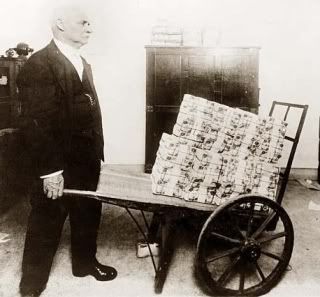
On November 6, 1923, the price of a loaf of bread in Berlin was reported to be about 140 billion German marks. And yet when we think of fine baking, we tend to think of France—clearly, we have done the Germans wrong.
The October Revolution, also known as the Bolshevik Revolution or the November Revolution, was the second phase of the Russian Revolution of 1917, the first having been instigated by the events around the February Revolution. The October Revolution was led by Vladimir Lenin and the Bolsheviks with the Mensheviks, Left Socialist-Revolutionaries and anarchists. It was the first Marxist communist revolution in history. Apparently communists don't have a firm grasp on dates.
On evening of October 23, 1917 (by the Julian calendar still in use in Russia at the time; November 5 by the current Gregorian calendar), the Russian Revolution took place, bringing the first Communist government in the world to power, under the control of Vladimir Lenin. There had been a semi-Democratic government in Russia since 1905, with the Czar (Tsar or Tzar) sharing power with a parliament. But the Czar had grown increasingly unpopular ( owing to the fact people couldn't agree on the spelling of his name and had to learn Cyrillic to spell it anyway), especially since the beginning of World War I. The Russian army was poorly equipped and poorly led (they were usually issued a sharpened stick and a rotten potato and led by men who knew how to correct address the head of their nation but wouldn't tell the unwashed masses), and Russian soldiers were slaughtered in the thousands by the Germans. World War I also disrupted the economy and created huge food shortages. Inflation raised the prices of available goods by more than 700% in just three years
(borscht only had become so expensive, that people had taken to drawing pictures of bowls of the beet soup and serving them to their starving children).
Soldiers began deserting the Russian Army and many of them went to St. Petersburg, where food riots broke out in the winter of 1917. There were demonstrations calling for an end to the war and an end to the Czar's rule. To prevent revolution, Tzar Nicholas II stepped down from the throne on March 15th, 1917 and he was replaced by a provisional government.
That summer, Russia experienced a brief taste of true democracy. Freedom of speech was granted to both individuals and newspapers for the first time. All political and religious prisoners were given amnesty. And all citizens were given the right to vote in secret ballot elections and to refer to the Tsar as that 'old Russian bastard'. But the provisional government decided to continue fighting in the extremely unpopular war against Germany, and that helped fuel opposition groups.
In April of 1917, Vladimir Lenin crossed the border back into Russia for the first time in ten years. He had been in exile in Switzerland, plotting how to start a socialist revolution. Lenin's argument was that capitalism had started the World War, and that the workers in the trenches fighting the war should turn their guns away from each other and instead fight a civil war to overthrow their leaders and take rightful control of their governments.
New political parties began to spring up. The second most popular party was, "Stay drunk all day with hot Russian chicks" party. Surprisingly, this was not the most popular party. Lenin's political party was called the Bolsheviks, and their slogan was "Peace, Land, and Bread." With the continuing unpopularity of the war, they quickly became the most popular political party in the country.
Lenin was accused of being a German spy by the provisional government in July 1917, so he had to go underground.It made party meeting very uncomfortable and dirty, to boot. In order to attend a meeting of the Bolsheviks in late October of that year, he had to wear a disguise (as Queen Victoria) and sneak through the city streets. He made it to the meeting undetected, and after a heated ten hour debate, he persuaded a majority of his party to launch an armed takeover of the country.
Lenin gave the order for the workers' militia to seize government buildings on this day in 1917, and the coup met almost no resistance (as there was little to no soap available for the workers, they were quite greasy). Official films made much later showed a huge storming of the Winter Palace and fierce fighting, but in reality the Bolshevik insurgents faced little or no opposition and were practically able to just walk into the building and take it over - more people were killed in the shooting of the film October than in the actual revolution. Then next day, Lenin was elected chairman of the Council of the new Soviet Government. Overnight, he had gone from a fugitive in hiding to the leader of the revolutionary government in the largest country in the world.
Lenin believed that a communist country would need to be ruled at first by a military dictatorship, but that once communism took hold, people would be so happy with the new system that most of the coercive elements of the government would wither away, and society would become a classless, stateless paradise. He also believed that bathing next to an Armenian gave you cooties (go figure). He said, "While the State exists there can be no freedom; when there is freedom there will be no State." His vision never came to pass.
Russia would remain a totalitarian police state for most of the rest of the twentieth century.
The camel has all of the good lines in this cartoon.
November 5, 1964 - An unsung minor masterpiece, Seance on a Wet Afternoon, premiered in the US on this date.
Kim Stanley should have won the Oscar for her performance in this film.
Today's Birthdays -
Joel McCrea (1905)
Roy Rogers (1911)
Ike Turner (1931)
Elke Sommer (1940)
Art Garfunkel (1941)
Sam Shepard (1943)
Tatum O'Neal (1963)
Today in History - November 5, 1605 - The Gunpowder Plot of 1605, or the Powder Treason, as it was known at the time, was a failed attempt by Guy Fawkes and a group of provincial English Catholics to kill King James I of England, his family, and most of the Protestant aristocracy in a single attack by blowing up the Houses of Parliament during the State Opening on this date.
The conspirators had also planned to abduct the royal children, (who were Protestant) not present in Parliament, and incite a revolt in the Midlands. the conspirators were captured before the plot could take place. They were all drawn and quartered.
On 5 November each year, people in the United Kingdom and other Commonwealth countries and regions celebrate the failure of the plot on what is known as Guy Fawkes Night, Bonfire Night, Fireworks Night, Cracker Night or Plot Night by getting drunk and setting things on fire.
November 5, 1895 - George B. Selden was a lawyer and inventor who was granted the first U.S. patent for an automobile, which he invented in 1877.
The idea of a horseless carriage was in the air during George's youth, but its practicality was uncertain. In 1859, his father, Judge Henry R. Selden, a prominent Republican attorney, moved to Rochester, New York, where George briefly attended the University of Rochester before dropping out to enlist in the Sixth U.S. Cavalry, Union Army. This was not to the liking of his father who after pulling some strings and having some earnest discussions with his son managed to have him released from duty and enrolled in Yale. George did not do well at Yale in his law studies, preferring the technical studies offered by the Sheffield Scientific School, but did manage to finish his course of study and pass the New York bar 1871 and joined his father's practice. He married shortly thereafter to Clara Drake Woodruff, by whom he had 4 children. He continued his hobby of inventing in a workshop in his father's basement, inventing a typewriter and a hoop making machine.
Selden's father, Henry Selden, was chosen by Abraham Lincoln to be Vice President, but he turned it down (and in light of Lincoln's assassination, Henry Selden would have otherwise been the next American President).
He defended Susan B. Anthony in her 1873 trial for unlawfully voting as a woman (had she only voted as a badger, there would have been no problem.)
It's an abbreviated additional this morning but I thought I'd start with this video:
contemplate the meaning of life as you watch the grasshopper still wriggling.
Today's word - Aeipathy: noun, continued passion; an unyielding disease. Michael Bloomberg's aeipathy for being mayor of NYC, borders on the pathological.
Today in History November 4, 1922 - It was on this day that a British man named Howard Carter made one of the greatest archeological discoveries of all time by discovering the tomb of King Tutankhamen (Boris Karloff).
Tut has been making his tour and putting a curse on those damn limeys who disturbed his eternal rest ever since.
November 4, 1963 - At a Beatles command performance (present: Queen Elizabeth; the Queen Mother; Princess Margaret), John Lennon utters the remark:
"Will the people in the cheaper seats clap their hands? And the rest of you, if you'll just rattle your jewelry."
November 4, 1979 - The US Embassy in Tehran is stormed by "students", holding 52 hostages for 444 days.
The incident propels Ted Koppel and his magnificent hair onto the national scene with a long series of repetitive Nightline: America Held Hostage specials.
Sneak home and make a housewife feel a little less desperate.
It's also National Sandwich Day - observed on the birthday of John Montague, Fourth Earl of Sandwich, creator of the sandwich.
To celebrate, begin gambling heavily, don't get up from the table for several hours and call for your manservant to bring you a slab of beef and two pieces of bread (and a piss pot).
November 3, 1955 - Another highlight from the end of the Golden Age of Hollywood Musicals, Guys and Dolls, premiered in NYC on this date.
Yeah, yeah, yeah - they cut some of the best numbers and Brando isn't much of a singer (Sinatra wanted the Sky Masterson role) but the movie is still a nice slice of of S & S cheesecake (I don't like Lindy's.)
Real New Yorkers deserve a real candidate
Write in C. Montgomery Burns. He's the only really animated candidate.
Word of the Day - Nequient: adjective, not being able. Estella was under the impression that most adult understood the need for deodorant, but judging from the aroma, she thought Hubbert was still nequient in this simple art.
Today in History November 3, 1913 -
Federal income tax law signed.
November 3, 1956 - "It looks like we're not in Kansas anymore." "Wizard of Oz" first televised (CBS-TV). Since most TV's at the time are black and white the technicolor part of the film is lost on the audience.
Kids, light up your spliffs (smoke 'em if you got 'em.)
November 3, 1957 - Laika the dog becomes the first living creature in space. She asphyxiated when oxygen in the Soviet Sputnik 2 ran out. However, some western researchers speculate that Laika roasted when the satellite's heat shields were detached.
I wonder if the Explorer's club served Roast Dog in her honor that year.
November 3, 1978 - Diff'rent Strokes premieres on NBC.
The cast's child actors have gone on to bigger and better things: Todd Bridges (arrests: drug possession, 1983; attempted murder, 1989; knife stabbing in self defense, no arrest, 1993; assault with a deadly weapon, 1997); Dana Plato (armed robbery, 1992, then a porno centerfold; dead of a drug overdose in 1999); Gary Coleman (a short, pudgy gun nut who plays Nintendo games; 2003 gubernatorial candidate).
Remember, plenty of water and broccoli will bring you back down to earth kids.
November 2, 1940 - Another funny Porky Pig Looney Tunes, The Sour Puss, premiered on this date.
Well now I've seen everything!
November 2, 1942 - Another Preston Sturges laugh out loud comedy, The Palm Beach Story, opened on this date. (Sturges, himself, had to shove a hankerchief in his mouth to avoid ruining a take by laughing.)
Hooray for the Ale and Quail Club!
November 2, 1957 - The often edited for S & P (I definitely should know) Bugs vs. Daffy Looney Tunes cartoon, Show Biz Bunny, premiered on this date.
I know, I know, but I can only do it once.
Scandiscope: noun, machine for cleaning chimneys. The screams of the horrified children confirmed Bert's worst fears: the scandiscope removed soot, as well as skeletal remains dressed in what appeared to be red rags.
Today in History - November 2, 1947 - In California, industrialist, film producer/director, philanthropist, syphilitic bisexual germaphobe Howard Hughes performs the maiden (and only) flight of the Spruce Goose; the largest fixed-wing aircraft ever built.
The plane was crafted out of 200 tons of plywood. The war ended before the plane was deployed
November 2, 1959 - Quiz show scandals: Twenty One game show contestant Charles Van Doren admits to a Congressional committee that he had been given questions and answers in advance.
November 2, 1974 - 78 patrons die when the Time Go-Go Club in Seoul, South Korea burns down. Six of the victims jumped to their deaths from the seventh floor after a club official barred the doors after the fire started.
That what they get for listening to that damn Rock and Roll Music.
November 2, 1984 - Velma Barfield becomes the first woman executed in the United States since 1962 for the murder of her mother, her boyfriend and two others with rat poison in their food.
That will learn her.
November 2, 1988 - The Internet Worm is released by Cornell grad student Robert Morris. His ingenious program was meant to explore the Internet harmlessly, but due to a bug, it crashed some 6,000 computers. Morris parlays the incident into a career, he is now an associate professor at MIT.
Don't forget the first guy that ran it died at the finish line.
Did you remember to set all of the clocks back - the VCR, the microwave, the automatic coffee pot in the kitchen?
Go ahead and check - you can come back to this later.
Today is also All Saints day, the feast celebrated on November 1 in Western Christianity, honoring all the saints, known and unknown.
It's also the first day of celebration The Day of the Dead (Día de los Muertos in Spanish), a holiday celebrated mainly in Mexico and by people of Mexican heritage (and others) living in the United States and Canada. The holiday focuses on gatherings of family and friends to pray for and remember friends and relatives who have died. The celebration occurs on the 1st and 2nd of November, in connection with the Catholic holy days of All Saints' Day and All Souls' Day.
Happy November!
According to the Gregorian calendar, November is the eleventh month of the year. In the early Roman calendar, it was the ninth month. The Roman Senate elected to name the eleventh month for Tiberus Caesar, and since Augustus time, it has had only 30 days. Originally, there were 30 days, then 29, then 31. This is what comes from too much of a good time - poor calendar making.
November's Birthstone is the Topaz or Citrine.
November's Flower is the Chrysanthemum.
November comes between the fall and winter months. The leaves are almost completely gone from the trees, and the rest have lost most of their color. The Anglo-Saxons referred to November as the 'wind month' and the 'blood month' - probably because this is the month they killed their animals for food.
Lots of activities come to a halt in November. The crops have been harvested and either put in storage, or sent to processing plants or mills. Farmers already know if their year has been successful or not. Football is the main sport of the month. The weather is usually beautiful for this kind of sport.
November is: Adoption Awareness Month, Alzheimer's Disease Month, Apple Month, Aviation History Month, Child Safety and Protection Month, Christmas Seals Month, Diabetes Month, International Drum Month, Epilepsy Month, Hospice Month, Native-American Heritage Month, Peanut Butter Lovers Month, Real Jewelry Month (and not Real Jewry Month) and Sleep Comfort Month.
Oh yeah, Thanksgiving occurs during November as well.
Today in History November 1, 79 - Pompeii, vacation playground for the Roman Empire is buried by Mt Vesuvius.
I can't keep repeating this - throwing any old whore into the lava pits will not appease the gods.
Mars needs women and Mountain gods want sacrificial VIRGINS not some skank.
November 1, 1512 -
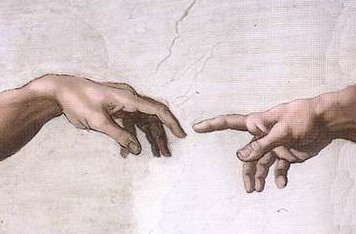
Michelangelo (Charlton Heston) finally stops milking the job and the Sistine Chapel ceiling is finally exhibited to public.
This was a very big day for William Shakespeare. On November 1, 1604, his tragedy "Othello" is first presented.
On November 1, 1611, his romantic comedy "The Tempest" is first presented.
November 1, 1870 - In the United States, the Weather Bureau (later renamed the National Weather Service) makes its first official meteorological forecast -
darkness approaching as night falls with a gradual increase of daylight as dawn comes on in the morning.
November 1, 1896 - A picture showing the unclad (bare) breasts of a (Zulu) woman appears in National Geographic magazine for the first time,
starting a trend of providing masturbation material to youth for decades.
November 1, 1939 - A rabbit that was born of artificial insemination is shown to the world.
History does not record why anyone felt that rabbits needed any help in the procreation department.
November 1, 1951 - US Soldiers are exposed to an atomic explosion for the first time in training exercises, at Desert Rock, Nevada.
Participation was not voluntary and served both to train and indoctrinate.
Ancient Romans celebrated a holiday called Feralia on February 21. At first it was a simple day off to recover from the holiday of February 20 (Bougainvalia), and to take care of last minute shopping before the holiday of February 22 (Onsalia).
It was, coincidentally, the last day of the year according to the Roman calendar.
Over time it became a sacred day in its own right. It became a festival to honor the dead, and like most Roman holidays it involved some serious drinking. Feralia also resembled most other Roman holidays in that it outlasted the western Roman empire. The jolly men and women of the Mediterranean basin saw no reason to give up the riotous holiday, with all its drinking and orgies, despite countless reminders from an ascendant Christian church that drinking was bad (unless it was Jesus' blood) and orgies were worse.
At last, in the 7th century, Pope Boniface IV decided that the holiday was Christian after all, except that instead of honoring all the dead it should honor only dead saints, that instead of Feralia it should be called All Saints' Day, that instead of drinking and orgies it should be a day of prayer and meditation, and that instead of February 21 it should be observed on May 13.
The good peoples of the Christian world happily accepted the new name and date, but persisted in drinking and orgying. As punishment for this inappropriate enjoyment, Pope Gregory III moved it to November 1, and unwittingly laid the foundation for our modern Halloween.
Hold that thought.
Since as early as the 5th century BC, the ancient Celts had considered October 31 the last day of summer. They called the day Samhain (rhymes with Clamhain), and they believed all the divisions between the world of the living and the world of the dead were dissolved for that brief period. They thought the dead used this window of opportunity to possess the souls of the living, and the thought scared the piss out of them.
A variety of bizarre rituals to ward off the dead accumulated around Samhain over the centuries, including the sacrificial burning of virgins (when any could be found).
When these Celtic rituals collided with the Christian All Saints' Day, all hell broke loose. People didn't know whether they should pray, drink, orgy, burn virgins, or what. They tried a lot of different combination: they got drunk and prayed, they burned virgins and got drunk, they prayed to have orgies and got drunk with virgins, they prayed then got drunk and had orgies with virgins.
Eventually they settled on sending their kids out in silly costumes to ask their neighbors for candy. This was intended to keep them out of the house while the drinking and orgies raged, but since everyone's doorbells kept ringing from everyone else's children, the drinking and orgies gradually faded away.
Of course, this brief outline only traces the development of Halloween as we know it in America. The holiday is still celebrated in countries all over the world in an astonishing number of ways.
In Bulgaria, for example, October 31 is a national holiday called "Bulgerplutz." In rural districts, children dress up as kitchen utensils and dash from farm to farm tying chickens' feet together. Any unhappy farmer attempting to shoo the children away from his chickens will find himself pelted with manure and glass shards as the children sing playful Bulgerplutz carols. In Mexico, the "Day of the Dead" lasts from October 31 through November 2, which has long been a concern to students of the Mexican calendar. The celebration is a fusion of sixteenth-century Spaniards' All Souls'and All Saints' Days and the Aztec festival honoring Mictecacihuatl, the Aztec goddess of the dead. (Mictecacihuatl was said to have died at birth as the result of complications relating to pronunciation.)
One can't help but marvel at the similarities between the "Day of the Dead" that arose in Meso-America and Kyrgyzstan's "Day of the Very Sick" (Nov 1), Papua New Guinea's "Evening of the Emotionally Exhausted" (Oct 31), and Vanuatu's "Cardiovascular Appreciation Days" (Oct 31 - Nov 2).
In Saudi Arabia, October 31 is "Sandy Night." As soon as the sun sets, children scamper out into the desert and fill their home-made bags with sand. The holiday is believed to be derived from the ancient Bedouin tradition of sending children out to fill bags with sand.
In Chile, Halloween is infused with ancient Incan traditions. Fretful mothers extinguish the fires in their hearths for fear of attracting Spaniards while naughty children take their parents hostage and demand their weight in chocolate.
In Wittenberg, Germany, October 31 is celebrated as the day on which Martin Luther nailed his 95 Theses to the door of the church in 1517. Many of the town's children frolic giddily about, nailing Theses here and there with impish delight, while others try to catch and burn them as heretics.
Whatever your own tradition, enjoy Halloween.
( For all you parents - remember to sort your kids candy later tonight. It is not a crime to save all the good chocolate for yourself. Tell'em you have to sample it for poison.) -
Word of the Day: Leporicide: noun, killer or killing of hares or rabbits. Elmer Fudd's futile attempts at leporicide were always foiled by his intended prey.
Today in History - October 31, 1926 - Harry Houdini dies in room 401 of Grace Hospital in Detroit.
The escape artist was killed by diffuse peritonitis, after having undergone an emergency appendectomy.
Contrary to popular belief, the fatal appendicitis could not have been caused by a punch to the stomach.
October 31, 1950 - John Franklin Candy, the great Canadian comedian and actor,
was born on this date.
October 31, 1993 - Federico Fellini, considered as one of the most influential and widely revered film-makers of the 20th century, passed away on this date.
I'd have written more but I'm way behind painting my body.
Kids, if this man answers the door tomorrow while you're Trick or Treating
Run !!!
October 30, 1937 - A good early Looney Tunes Halloween treat, The Case of the Stuttering Pig, was released on this date.
I'm the guy in the thoid row, you big sourpuss!
October 30, 1943 - A very funny war-time Bugs Bunny Cartoon, Falling Hare, was released on this date.
This is an unusual Looney Tunes in that Bugs does not have the upper hand and is somewhat of a stooge.
Aporrhoea: noun, a bodily emanation; an effluvium. The meal of Frank and Beans was excellent although was ruined because of the unfortunate episode of aporrhoea.
Here's your Today in History - October 30, 1863 - OK kids, try to follow this ... Danish Prince Wilhelm was a middle child of very famous siblings.
His older brother was to become the King of Denmark.
His older sister was married to Edward VII, making her the Queen consort of England.
His younger sister was married to the Tsar (czar? csar?) of Russia.
His parents didn't know what just to get for him. They thought and thought about it and decided that he should become the King of Greece?
Wilhelm arrives in Athens, changes his name to a good Greek name and assumes his throne as George I, King of the Hellenes, on this date. As mentioned previously, Wilhelm/ George's grandson was a sailor named Philippos,
whose parents were related to themselves and half the other nobility in Europe. Philip had no real prospects of a career, so he did what any blue blooded aristocrat would do with no real prospects, he married up by marrying his second cousin (Elizabeth II of England).
October 30, 1938 - The War of the Worlds was an episode of the American radio drama anthology series Mercury Theatre on the Air. Directed by boy wonder, Orson Welles, the episode was an adaptation of H. G. Wells' classic novel The War of the Worlds (1898), and was performed as a Halloween special on this date. Welles's adaptation is arguably the most well-known radio dramatic production in history. Both the War of the Worlds broadcast and the panic it created have become textbook examples of mass hysteria and the delusions of crowds.
It has been suggested in recent years that the War of the Worlds broadcast was actually a psychological warfare experiment. In the 1999 documentary, Masters of the Universe: The Secret Birth of the Federal Reserve, writer Daniel Hopsicker claims that the Rockefeller Foundation actually funded the broadcast, studied the ensuing panic, and compiled a report that was only available to a chosen few. A variation of this conspiracy theory has the Princeton Radio Project and the Rockefeller Foundation as co-conspirators.
There has been continued speculation that the panic generated by the War of the Worlds broadcast inspired officials to cover up unidentified flying object evidence, to avoid a similar panic. Indeed, U.S. Air Force Captain Edward J. Ruppelt wrote in 1956, "The [U.S. government's] UFO files are full of references to the near mass panic of October 30, 1938, when Orson Welles presented his now famous The War of the Worlds broadcast."
It's also possible that the aliens hypnotizing Welles and causing him to pass the broadcast off as a drama, when it was indeed factual.
You never know.
October 30, 1968 - Silent film star, Ramon Navarro is brutally beaten and left for dead by his assailants, on this date. Novarro's life ended when two Catholic brothers, Tom and Paul Ferguson, whom he had paid to come to his Laurel Canyon home for sex, murdered him.
According to the prosecution in the Novarro murder case, the two young men believed that a large sum of money was hidden in Novarro's house. The prosecution accused them of torturing Novarro for several hours to force him to reveal where the nonexistent money was hidden. They left with a mere twenty dollars they took from his bathrobe pocket before fleeing the scene.
Novarro died as a result of asphyxiation, choking to death on his own blood after being brutally beaten. According to filmmaker and scandal monger, Kenneth Anger, Navarro actually died after suffocating on a wooden (or silver) dildo (a gift from Rudolf Valentino) the two brothers crammed down his throat.