If you find yourself in Rome, run - do not walk - to Santa Maria della Vittoria. The church houses one of the most astonishing works of art: The Ecstasy of St. Teresa by Bernini.
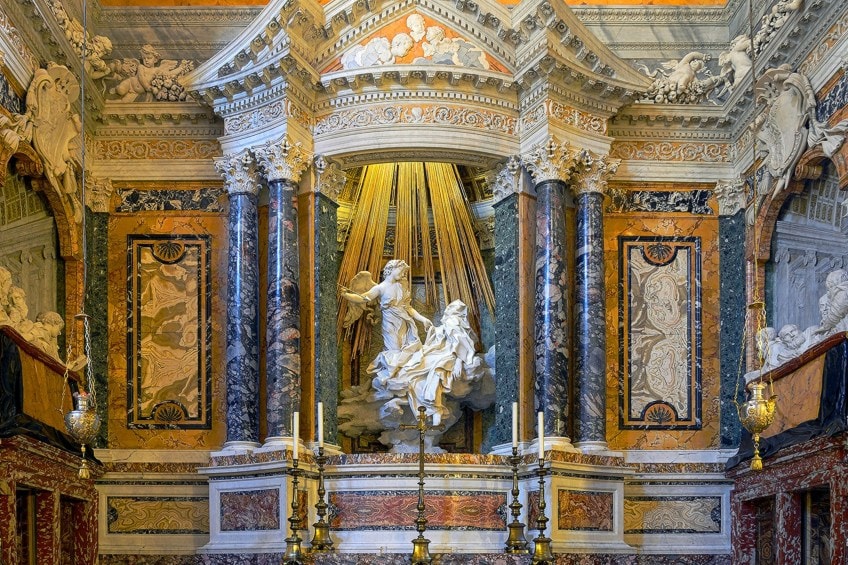
The sculpture depicts a moment described by St. Teresa in her autobiography, when she had a vivid vision of an angel piercing her heart with a golden shaft, over and over again, filling her with both immense joy and pain. Bernini’s flowing robes and contorted figures abandon classical restraint, capturing instead a more passionate, almost voluptuous trance.
Such is my obsession with religion.
Today is also National Dog Day, reminding potential dog owners to adopt their dogs from shelters, rather than buying from pet stores.
But why isn't it celebrated during the dog days of summer?
The first time toilet paper was ever sold on a roll was on August 26, 1871 (Joseph Gayetty, often created as 'the father of modern TP' sold his product in packets of flat sheets.) August 26 was later officially dubbed National Toilet Paper Day. (Seth Wheeler patents rolled and perforated toilet paper (U.S. patent No. 117355) on July 25, 1871.)
The Chinese took a break from inventing everything else and were thought to have create TP on this date in 580 AD. They were far too serious to be messing around with any old orgies not to note the correct date.
August 26, 1953 -
Considered to be one of the great science fiction films of the 1950s, George Pal's The War of the Worlds was released on this date.
The Martian war machines had about twenty wires running to each one. Some were for suspension and maneuvering, while others carried power to the various lights and mechanisms. This was produced before there were lightweight circuits and sophisticated radio controls.
August 26, 1955 -
Satyajit Ray burst onto the international film scene, when his directorial debut Pather Panchali, starring Subir Banerjee, Kanu Banerjee and Karuna Banerjee, premiered in India on this date.
Halfway through filming, Ray ran out of funds. The Government of West Bengal loaned him the rest, allowing him to complete the film. This loan is listed in public records at the time as "roads improvement", a nod to the film's translated title.
August 26, 1957 -
The Hammer horror film The Abominable Snowman (US title: The Abominable Snowman of the Himalayas), directed by Val Guest and starring Forrest Tucker (the man who go head-to-head with Uncle Miltie in a match-up) and Peter Cushing premiered in the UK on this date.
The film is based on The Creature, a BBC Television play by writer Nigel Kneale. It follows an English anthropologist on an American expedition searching the Himalayas for the legendary Yeti
August 26, 1968 -
Warner Bros.-Seven Arts released Paul Newman's directorial debut, Rachel, Rachel, starring Joanne Woodward, Estelle Parsons, James Olson, and Geraldine Fitzgerald on ths date.
The production was a small-scale one, with a small budget (reportedly only $700,000) but it eventually emerged as quite a big moneymaker, as well as being one of the studio's prestige movies of its year.
August 26, 1972 -
The romantic drama directed by Elia Kazan and produced by Sam Spiegel, based on Harold Pinter's screenplay adaptation of F. Scott Fitzgerald's unfinished novel The Last Tycoon on this date. It stars Robert De Niro, Tony Curtis, Robert Mitchum, Jack Nicholson, Donald Pleasence, Jeanne Moreau, Theresa Russell and Ingrid Boulting.
Mike Nichols was replaced after disagreements with Sam Spiegel. Allegedly, Nichols opposed the casting of Robert De Niro in the lead. Soon afterwards, Nichols worked on another project planned for De Niro, an original comedy script by Neil Simon titled Bogart Slept Here This, too, came to nothing, amidst rumors of considerable friction between De Niro and Nichols, who then abandoned filmmaking for several years. Simon later rewrote his script extensively, and it emerged as The Goodbye Girl , but with Richard Dreyfuss in the lead, and Herbert Ross directing.
August 26, 1972 -
Looking Glass' single Brandy (You're A Fine Girl) hit No. 1 on this date.
This was not typical of the band's sound, which caused a problem at concerts. While audiences expected pop songs like this one, the Looking Glass played rock, which left the crowds disappointed. The band broke up less than two years later.
August 26, 1983 -
The David Bowie film Merry Christmas Mr. Lawrence, co-starring Tom Conti, Ryuichi Sakamoto, and Takeshi Kitano opened on this date
Lourens van der Post, the author of this film's source novel The Seed and The Sower, once said of this filmed adaptation of his novel: "This is a great and deeply moving film. The only war film I have ever seen that does not exploit the surface drama and horrifics of war, but penetrates into the origins and meaning of war in the human spirit. Moreover, it is honest and brave, and looks with the same unevasive and unblinking eyes into the character of Japanese and Europeans alike."
August 26, 1998 -
Lauryn Hill releases her solo album, The Miseducation of Lauryn Hill on this date.
The album was named after The Mis-Education Of The Negro, a book by Professor Carter G. Woodson, an American black history expert, and The Education of Sonny Carson, an autobiographical film about the title controversial activist. It went on to become the first hip-hop album to win the Grammy for Album of the Year.
Today's moment of Zen
Today in History:
August 26, 1498 -
A statue was commissioned for the tomb in St. Peters for the French cardinal Jean de Billheres (who was a representative in Rome), on this date.
Michelangelo (23 at the time) won the commission to make the Pieta.
August 26, 1743 -
Antoine Laurent Lavoisier was born on this date. Dr. Lavoisier discovered Oxygen (Joseph Priestley may beg to differ) but not on this date; he was usually too busy celebrating his birthday.
The discovery was a great boon to science, as it enabled Breathing, without which many subsequent scientific advances would have been impossible.
August 26, 1883 -
Krakatoa erupted, between Java and Sumatra on this date. The two-day eruption and related tidal waves killed 36,000 people and destroyed two thirds of the island. (Yeah, yeah, I know, Krakatoa is West of Java.)
On a lighter note, "Krakatoa" sounds like "cracked a toe, huh?" and can be used in many humorous puns.
August 26, 1920 -
The Nineteenth Amendment, guaranteeing women the right to vote, was formally adopted into the U.S. Constitution, on this date.
The amendment had been first introduced in Congress in 1878, setting in motion supporters who demonstrated, lobbied, marched and spoke out for woman suffrage. They were often met with venomous opposition. Early on, the two main factions of the movement disagreed about how to achieve their goal, but they ultimately united in 1890 to form the National American Woman Suffrage Association and worked together to get the amendment passed. By August 18, 1920, three-fourths of the United States had agreed to the bill. Secretary of State Bainbridge Colby certified ratification of the Nineteenth Amendment on this date.
August 26, 1930 -
Philo Farnsworth at 24, was finally granted a patent (US Patent No 1,773,980) for a television system on this date. The patent was has been repeatedly delayed by RCA legal action. This is his first patent, with a description of his image dissector tube, which will be his most important contribution to the development of television. He had begun working on this concept at an early age, gained some financial support for his research, and worked in a small laboratory with limited assistance.
Farnsworth ultimately held patents covered scanning, focusing, synchronizing, contrast, controls, and power. He also invented the first cold cathode ray tubes, the first simple electronic microscope, used radio waves to get direction (later called radar), and black light for seeing at night. During the 1960s he worked on special-purpose TV, missiles, and peaceful uses of atomic energy.
August 26, 1957 -
Henry Ford was a very plain man; he wasn't interested in anything fancy. Ford left the design stylings of the Model A (during the late 20s, early 30s) to his son Edsel. The Model A pretty much saved the company, at the time.

110,847 of the cars are built before Ford pulls the plug due to lack of sales.
And so it goes.

No comments:
Post a Comment